Jinhyun Park (박진현, KAIST)
Visitors
Jinhyun Park (박진현) Visitor (2022.8.15-2023.8.14) from KAIST Office: B248
복소기하학연구단
Jinhyun Park (박진현) Visitor (2022.8.15-2023.8.14) from KAIST Office: B248
Speaker Guolei Zhong IBS-CCG As a fundamental building block of the equivariant minimal model program, the rationally connected variety plays a significant role in the classification of projective varieties admitting non-isomorphic endomorphisms. Twenty years ago, Nakayama confirmed Sato’s conjecture that, a smooth projective rational surface is toric if and only if it admits …
Speaker Ziquan Zhuang Johns Hopkins U Several years ago, Chi Li introduced the local volume of a klt singularity in his work on K-stability. The local-global analogy between klt singularities and Fano varieties, together with recent study in K-stability lead to the conjecture that klt singularities whose local volumes are bounded away from …
Speaker Benjamin McMillan IBS-CCG The Killing operator in (semi) Riemannian geometry has well understood kernel: the infinitesimal symmetries of a given metric. At the next level, the range of the Killing operator can be interpreted as those perturbations of the metric that result from a mere change of coordinates---in contexts like general relativity, …
Speaker Jakub Witaszek Princeton U What allowed for many developments in algebraic geometry and commutative algebra was a discovery of the notion of a Frobenius splitting, which, briefly speaking, detects how pathological positive characteristic Fano and Calabi-Yau varieties can be. Recently, Yobuko introduced a more general concept, a quasi-F-splitting, which captures much more …
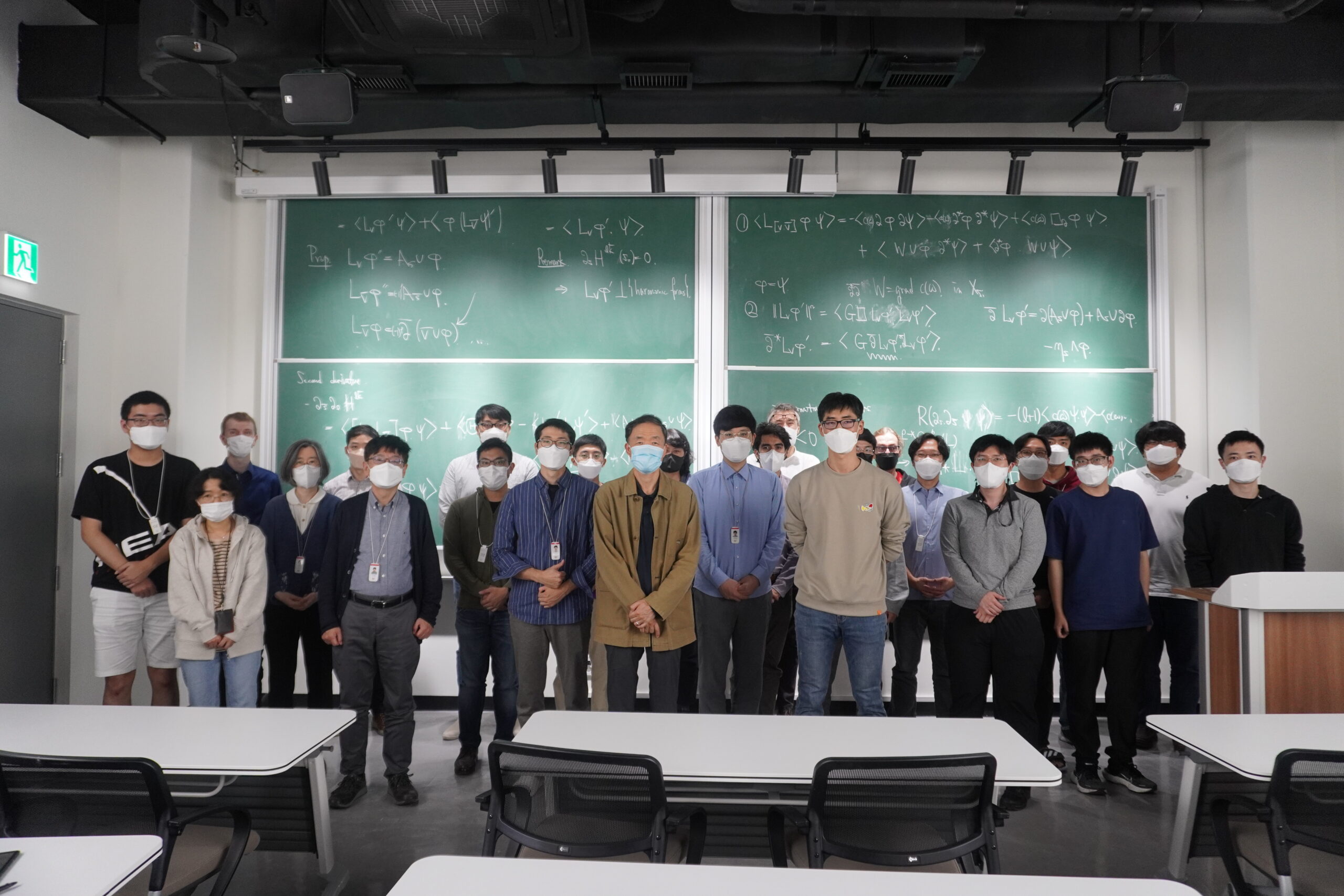
Speakers Young-Jun Choi (Pusan National U.) Yoshinori Hashimoto (Osaka Metropolitan U.) Dano Kim (Seoul National U.) Takayuki Koike (Osaka Metropolitan U.) Seungjae Lee (IBS-CCG) Nguyen Ngoc Cuong (KAIST) Mihai Paun (Bayreuth U.) Martin Sera (Kyoto U. Advanced Science) Jihun Yum (IBS-CCG) Schedule Oct. 5 Infinitesimal extension of twisted canonical forms and …
Speaker Pak Tung Ho Sogang University In this talk, I will explain what the weighted Yamabe problem is, and mention some related results that Jinwoo Shin (KIAS) and I obtained.
Speaker Aeryeong Seo Kyungpook National University TBA
Speaker Jinhyun Park KAIST The classical reciprocity theorem, also called the residue theorem, states that the sum of the residues of a rational (meromorphic) differential form on a compact Riemann surface is zero. Its generalization to smooth projective curves over a field is often called the Tate reciprocity theorem. There is a different …
Speaker Jaewoo Jeong IBS CCG The Hankel index of a real variety is a semi-algebraic invariant that quantifies the (structural) difference between nonnegative quadrics and sums of squares on the variety. Note that the Hankel index of a variety is difficult to compute and was computed for just few cases. In 2017, …
Speaker Livia Campo KIAS The classification of terminal Fano 3-folds has been tackled from different directions: for instance, using the Minimal Model Program, via explicit Birational Geometry, and via Graded Rings methods. In this talk I would like to introduce the Graded Ring Database - an upper bound to the numerics of Fano …