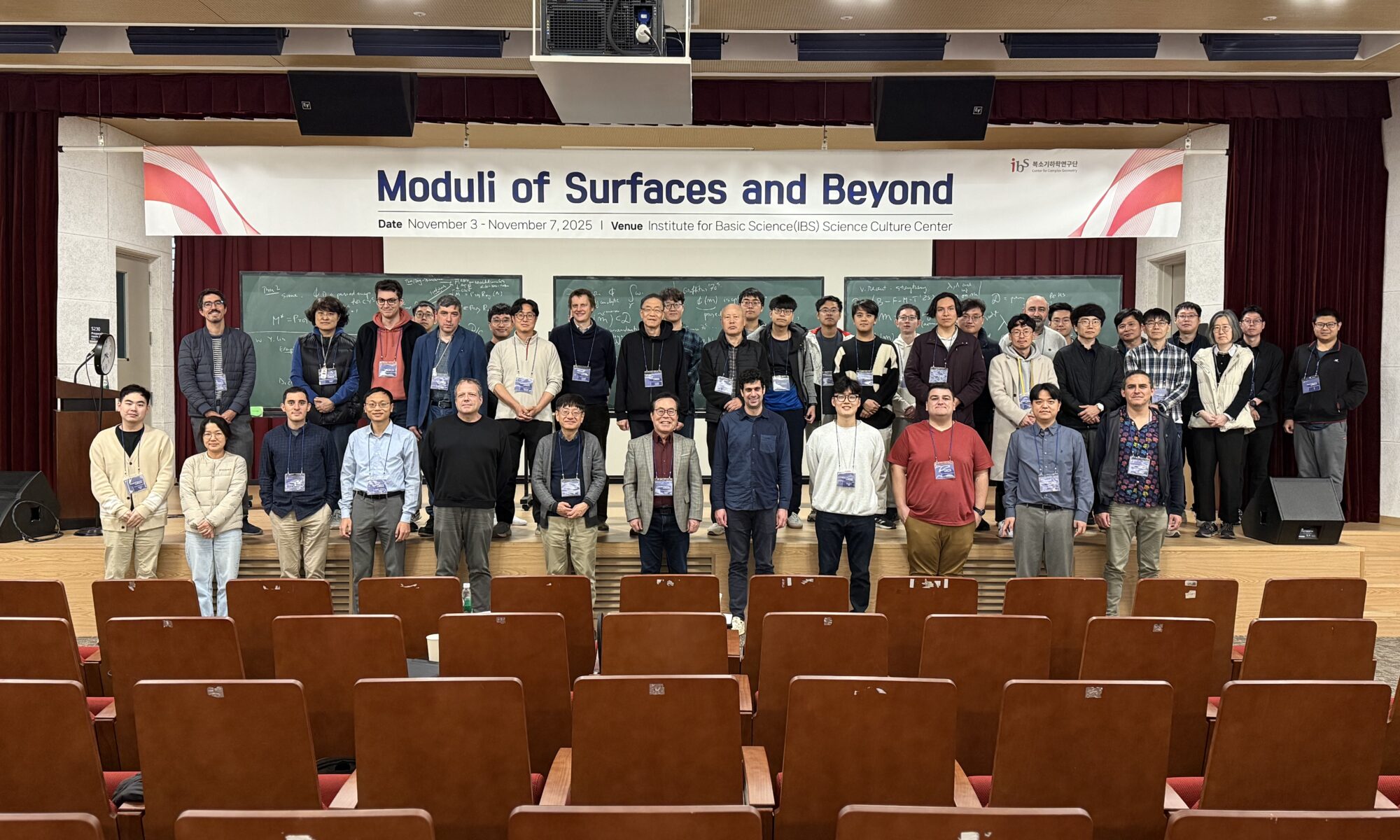
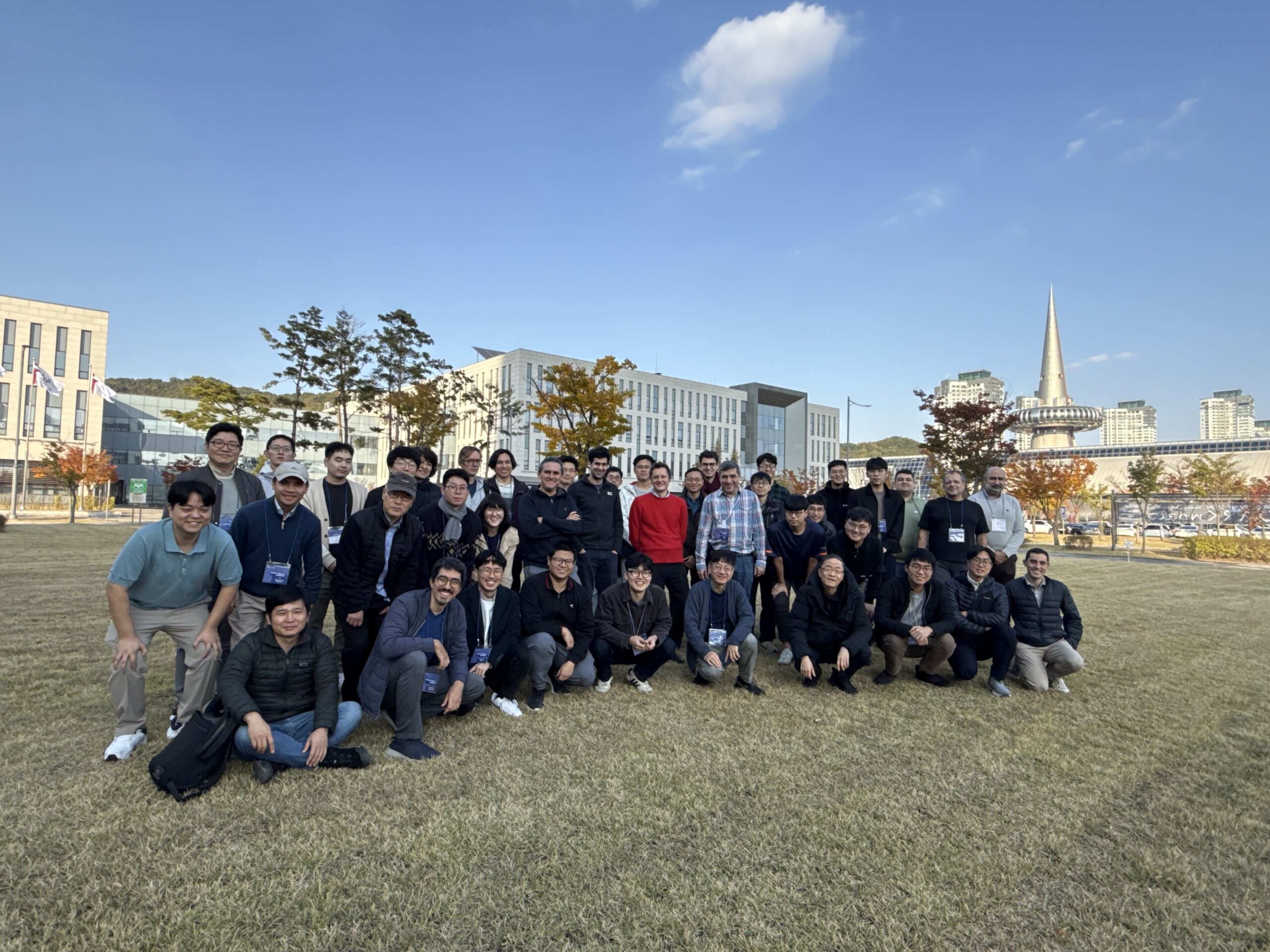
Moduli of Surfaces and Beyond


Speakers

Lecture Series (3hr)

Radu Laza (Stony Brook University)
Matthias Schütt (Leibniz Universität Hannover)
Jenia Tevelev (University of Massachusetts Amherst)

Research Talks (1hr)

Kenneth Ascher (University of California, Irvine)
Dori Bejleri (University of Maryland, College Park)
Harold Blum (Georgia Institute of Technology)
Nathan Chen (Harvard University)
Changho Han (Korea University)
Donggun Lee (IBS-CCG)
Samouil Molcho (Sapienza Università di Roma)
Giancarlo Urzua (Pontificia Universidad Católica de Chile)

Abstracts

PDF file

Schedule

Mon Tue Wed Thu Fri
10:00~11:00 Registration Schütt 2 Schütt 3 Urzua Han
11:00~11:30 Coffee break Coffee break Coffee break Coffee break Coffee break
11:30~12:30 Schütt 1 Laza 2 Laza 3 Ascher Chen
12:30~14:30 Lunch Lunch Lunch Lunch Lunch
14:30~15:30 Laza 1 Tevelev 2 Tevelev 3 Bejleri Lee
15:30~16:00 Coffee break Coffee break Coffee break Coffee break
16:00~17:00 Tevelev 1 Molcho Blum
17:30~20:00 Dinner for Speakers Banquet Dinner for Speakers Dinner for Speakers

Organizers

DongSeon Hwang (IBS-CCG)
Donggun Lee (IBS-CCG)
Yongnam Lee (IBS-CCG)

Venue

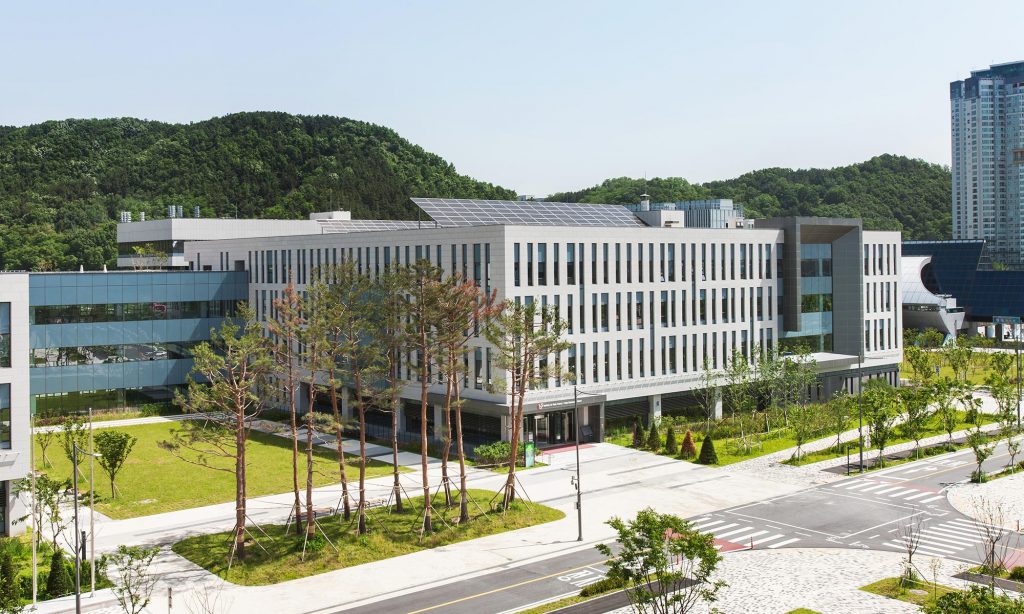
IBS Science Culture Center, Daejeon, Korea

Registration

Please submit Google form by October 15.

Main Hotel

Lotte City Hotel Daejeon (4-30 Doryong-dong, Yuseong-gu, Daejeon)

More Information

How to get to IBS-CCG
From Hotel to IBS

Giancarlo Urzua, The Birational Geometry of Markov Numbers

    Speaker

Giancarlo Urzua
Pontificia Universidad Catolica de Chile

The projective plane is rigid. However, it may degenerate to surfaces with quotient singularities. After the work of Bădescu and Manetti, Hacking and Prokhorov 2010 classified these degenerations completely. They are Q-Gorenstein partial smoothings of P(a2, b2, c2), where a, b, c satisfy the Markov equation x2+y2+z2=3xyz. Let us call the corresponding degenerations Markovian planes. They are part of a bigger picture of degenerations with Wahl singularities, where there is an explicit MMP whose final results are either K nef, smooth deformations of ruled surfaces, or Markovian planes. Although it is a final result of MMP, we can nevertheless run MMP on small modifications of Markovian planes to obtain new numerical/combinatorial data for Markov numbers via birational geometry. New connections with Markov conjecture (i.e. Frobenius Uniqueness Conjecture) are byproducts. This is joint work with Juan Pablo Zúñiga (Ph.D. student at UC Chile), the pre-print can be found here https://arxiv.org/abs/2310.17957.

Giancarlo Urzua, N-resolutions

     Speaker

Giancarlo Urzua
UC Chille

(This is a part of Seminars on Algebraic Surfaces and Related Topics.)

I will introduce N-resolutions, which are the negative analog of the Kollár–Shepherd-Barron (1988) P-resolutions of a 2-dimensional cyclic quotient singularity. (We instead work with the corresponding M-resolutions of Benkhe-Christophersen (1994).) I will start by describing an algorithm to find all of them based on the explicit algorithm for P-resolutions in Park-Park-Shin-Urzúa (2018) (that geometrically recovers Christophersen-Stevens’ zero continued fractions correspondence (1991)), which in turn is based on the explicit MMP described by Hacking-Tevelev-Urzúa (HTU 2017). I will also describe another way to find N-resolutions via antiflips (HTU 2017) starting with an M-resolution, showing an action of the braid group on all its associated Wahl resolutions. This will bring us to Hacking exceptional collections (2013-2016) on surfaces that are Q-Gorenstein smoothings of particular singular surfaces, where Karmazyn-Kuznetsov-Shinder (2022) have described their derived categories via derived categories of the Kalck-Karmazyn algebras (2017). This can be put together through Kawamata’s bundles (2018-2022), and I will describe our main theorem on semi-orthogonal decompositions defined by these M- and N-resolutions. I will end with applications to all simply-connected Dolgachev surfaces. I will mention open problems. This is on the joint recent work with Jenia Tevelev. This computer program finds all M- and N-resolutions.

Seminars on Algebraic Surfaces and Related Topics

     Schedule

Feb. 27

      1. N-resolutions
        Giancarlo Urzua (UC Chille)
        13:30-14:20


      2. Smooth Projective Surfaces with Pseudo-effective Tangent Bundles
        Guolei Zhong (IBS-CCG)
        14:40-15:30


      3. Nodal Surfaces and Cubic Discriminants
        Yonghwa Cho (IBS-CCG)
        15:50-16:40


      4. Lagrangian Fibration Structure on the Cotangent Bundle of a Del Pezzo Surface of Degree 4
        Hosung Kim (IBS-CCG)
        17:00-17:50


      5. Dinner
        18:20-20:00

Feb. 28

      1. Deformations of Sandwiched Surface Singularities and the Minimal Model Program
        Dongsoo Shin (Chungnam National U.)
        10:00-10:50


      2. Mori Dream Surfaces of General Type with pg=0
        JongHae Keum (KIAS)
        11:10-12:00


      3. Lunch
        12:00-13:00

Giancarlo Urzúa, Wormholes: MMP, Topology, Continued Fractions

     Speaker

Giancarlo Urzúa
Pontificia Universidad Catolica de Chile

We defined wormholes in https://arxiv.org/abs/2102.02177 (joint with Nicolás Vilches). Conjecturally it is a way to non-continuous travel in the KSBA compactification of the moduli space of surfaces of general type. It depends on a particular MMP. In that paper, we verified the conjecture in several cases, but many remain open. Beyond the certainty of the conjecture, it would be interesting to know about changes in the topology or differential structure after traveling through a wormhole. In this talk, I will exemplify what we know, and I will state open questions, which also include a mysterious combinatorial invariant delta that remains constant in this journey and seems to be part of some particular sequence of integers.

IBS 복소기하학연구단 Center for Complex Geometry
기초과학연구원 복소기하학연구단
대전 유성구 엑스포로 55 (우) 34126
IBS Center for Complex Geometry
Institute for Basic Science (IBS)
55 Expo-ro Yuseong-gu Daejeon 34126 South Korea
Copyright © IBS 2020. All rights reserved.